
A slow tourism route around Giarre, Riposto and the slopes of Mount Etna, designed for tour operators seeking a guided tour with local experiences to include in their eastern Sicily itineraries, including the area around Taormina. The tour lasts approximately 8 hours, for small groups with a maximum of 10–12 participants. The route connects the lava landscape near Milo, Sant’Alfio’s Mother Church and the Hundred Horse Chestnut, Giarre’s architecture, Riposto’s harbour and the Artesole workshop, with a decorating activity and time to discover local flavours.
This proposal develops the story of Le Vie della Lava, the Lava Routes, through a slower approach. It gives guests time to explore the places where basalt becomes landscape, paving, craft material and part of a community’s memory. Incoming agencies and DMCs can build a day around a clear theme and encounters rooted in the local area.
Slow tourism in eastern Sicily: giving time to places and people
Slow tourism is an approach to travel that makes room for observing places, listening to people and participating in local activities. On this route, time allows guests to recognise the stone beneath their feet, ask a craftswoman how a decoration takes shape and understand the relationship between the volcano and the coastal towns.
For a tour operator, the quality of the experience depends on the choice of stops and the pace of the day. Pauses allow travellers to take photographs, ask questions and connect what they have seen. A small group supports conversation and individual attention during the workshop.
The itinerary suits travellers interested in material culture, landscape, photography, craftsmanship and food. Walks and transfers should be organised around participants’ needs, with enough time for each encounter.
Mount Etna connects landscape, architecture and craftsmanship
On Etna’s eastern slopes, the landscape reflects the relationship between lava flows and human activity. Basalt has been used in buildings and paving, while local communities have developed farming, crafts and techniques for transforming volcanic material.
Following these connections makes the area easier to understand through tangible examples. Stone observed near its extraction site takes another form in Giarre’s paving slabs; at the workshop, the same material is cut, glazed and decorated. The route brings together geology, architecture and creativity.
To introduce clients to the project, explore the story of the Lava Routes and Mount Etna’s lava stone.
Near Milo: discovering the origins of lava stone
The regional itinerary starts in the Milo area, where the project includes learning about a basalt quarry. This stop introduces the stone before it is worked, explains the extraction of blocks and follows the material’s journey towards local workshops and businesses.

The story includes the 1928 lava flow, which destroyed the old town of Mascali and profoundly changed this part of Etna’s eastern flank. Remembering that event helps explain how landscape and community history are intertwined. The eruption and Mascali’s reconstruction are also documented by INGV, Italy’s National Institute of Geophysics and Volcanology.
Quarry access, the observation point and visit arrangements must be agreed before confirming the programme. The tour operator can then describe the activities that will actually be available on the chosen date.
Sant’Alfio: the Mother Church and the village’s lava stone
In Sant’Alfio, a stop at the Mother Church of Saints Alfio, Filadelfo and Cirino introduces an Etna village and its traditions. The lava stone façade shows another use for basalt: the volcano’s material becomes architecture and a focal point for the community.

Devotion to the three martyr brothers is part of the village’s memory; the Terre dell’Etna e dell’Alcantara Ecclesiastical Cultural Park describes their connection with Sant’Alfio. The stop allows time to observe the church, the square and the surrounding landscape. Any visit inside is arranged around opening times and religious services.
The Hundred Horse Chestnut: history and legends of an ancient tree
In the Sant’Alfio area, the Castagno dei Cento Cavalli, or Hundred Horse Chestnut, provides a stop devoted to Etna’s nature and memory. A CREA study published in 2022 gives its age as approximately 2,200 years and confirms that the three main trunks belong to the same organism. Standing before this tree means encountering a history spanning many generations.

Its importance was already recognised in 1745, when a protective measure covered the trees of the Carpineto woodland, where the chestnut grows. This episode, recalled by the Etna Park, offers a starting point for discussing landscape care and the value of monumental trees.
Its name preserves a popular legend: a queen named Giovanna, caught in a storm with a hundred knights and their horses, is said to have sheltered beneath its great canopy. Different versions identify the queen as Giovanna of Aragon or Giovanna of Anjou. This is a traditional tale, expressing the wonder inspired by the tree’s size.
For tour operators, this stop adds time for observation and storytelling, connecting the long life of nature with the story of stone and craftsmanship. The stop allows for the tale, photographs and a visit to the area under the agreed arrangements.
Giarre at a slower pace: squares, paving and architecture
In Giarre, lava stone becomes part of urban life. Piazza Duomo, Via Callipoli and Corso Italia provide opportunities to see how basalt has become paving and part of the town’s identity.

A walk with time to examine details connects the material encountered near Milo with its use in public spaces. The colour of the paving slabs, the worked surfaces and the relationship between streets, buildings and squares become elements of the story.
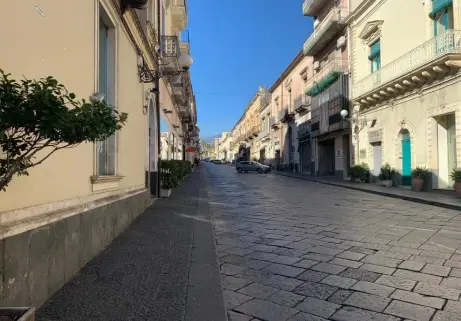
Giarre also offers an opportunity to discover basalt craftsmanship. The workshop visit continues this reading of the town, connecting architecture with the people who cut, decorate and glaze Etna’s stone today.
Riposto: where the Etna landscape meets the sea
The route reaches Riposto and its marina on the Ionian coast. Here, the view opens towards the sea, the boats and the outline of Mount Etna, completing the journey from the volcano’s slopes to the coast.
This stop gives guests time to observe the landscape and understand the relationship between the two towns. Giarre and Riposto can be presented as complementary parts of one experience: urban spaces and craftsmanship, the harbour and the sea horizon, connected by the volcano.
Within a slow tourism itinerary, this moment has a clear purpose. It helps travellers recognise the setting in which the activities encountered during the day take place, with time for photography and observation.
Artesole: meeting craftspeople and taking part
At the Artesole workshop, Via Marsala 40 in Giarre, guests discover where basalt is transformed. They learn about the stages of production: cutting slabs, shaping, glazing, decorating and firing.
The change from raw stone to a decorated surface becomes understandable through objects and the work of the craftspeople. The pieces on display show the possibilities of the material, from furnishings to artistic creations.

The hands-on activity involves decorating a tile or a small object with a tutor’s support. Travellers try part of the process themselves and create a personal reminder of the route.
Firing takes place after decoration: the finished object is scheduled for handover the following day. Collection or shipping, at the customer’s expense, must be arranged during planning. This allows the tour operator to manage the next stage of the journey without promising immediate handover.
Le Vie della Lava
From Etna lava to works of art
The Artesole video explores the transformation of lava stone, offering a closer look at the theme connecting the route’s stops.
Etna’s flavours and time around the table
The project connects craftsmanship with local produce. The document describing the Lava Routes mentions Giarre potatoes, verdello lemons, honey, Bronte pistachios and Etna wines, among other examples.
These products offer starting points for discussing the agricultural landscape and its communities. The food stop becomes a chance to talk and share, bringing the day’s connection with the area to the table.

The food selection, drinks and any dietary requirements are agreed in the quotation. The products mentioned illustrate the route’s wider context; the group proposal will specify what is actually provided.
Slow tourism near Taormina: fitting the route into a trip
For tour operators creating eastern Sicily itineraries, including the area around Taormina, Giarre and Riposto offer a day devoted to understanding the Etna region. The experience can sit alongside cultural and landscape visits already included in a programme, adding craft encounters and direct participation.
The route takes place around Milo, Sant’Alfio, Giarre and Riposto. Any visit to Taormina belongs to the tour operator’s wider programme; the meeting point, transfers and return arrangements should be agreed as part of the overall travel plan.
Giving this experience its own space helps preserve the slower pace. The eight-hour itinerary allows for the stops, activities and breaks; fitting it into the wider trip must also take the agreed logistics into account.
A guided tour for tour operators: approximately 8 hours, maximum 10–12 participants
This slow tourism route is designed for small groups with a maximum of 10–12 participants, to be settled when booking, and a total duration of approximately 8 hours. The order of stops and departure time are agreed according to the date and the group’s needs.
| Item | Information for tour operators |
|---|---|
| Area | Milo, Sant’Alfio, Giarre and Riposto, on the eastern side of Mount Etna |
| Total duration | Approximately 8 hours |
| Participants | Maximum 10–12 people; capacity agreed when booking |
| Experiences | Lava landscape, Sant’Alfio’s Mother Church, Hundred Horse Chestnut, town walks, harbour, Artesole visit, decorating activity and food stop |
| Arrangements | Dates, quarry access, transfers, accompanying staff and visit language to be agreed |
| Decorated object | Handover the following day; collection or shipping to be arranged |
| Price | Direct quotation based on the agreed programme |
The short visit for tour operators and groups lasts around 90 minutes and focuses on the workshop. The eight-hour regional itinerary also gives time to places and landscapes. This distinction helps operators select the experience that suits their clients.

Request a slow tourism itinerary for your group
To prepare a proposal, tell Artesole your preferred date, number of participants, accommodation location, available time and group language. Include dietary or mobility requirements so that walks, access and transfers can be considered before the trip is confirmed.
Contact Giuseppe Sorbello on +39 347 1874481, with telephone enquiries in Italian, or email infoartesolegiarre@gmail.com, specifying your interest in the approximately eight-hour regional slow tourism itinerary. Please make contact at least 30 days in advance; availability, inclusions and the total cost will be set out in the proposal.
For a tour operator, the value of this day lies in connecting what travellers observe with what they can experience: stone in the landscape, towns built with basalt, meetings with craftspeople and time shared around the table.
Frequently asked questions about the slow tourism route
What makes this a slow tourism route?
The route connects lava landscapes, towns, craftsmanship and local food, allowing time for observation, encounters and participation in the Artesole workshop. It is designed for tour operators, incoming agencies and DMCs.
How long does the guided tour last?
The total duration is approximately 8 hours. Departure time, the order of stops and group logistics are agreed when booking.
What is the maximum group size?
The route is designed for a maximum of 10–12 participants. Group capacity is settled when booking; 10–12 does not indicate a required minimum.
Which places does the route connect?
The stops connect the Milo area, Sant’Alfio’s Mother Church, the Hundred Horse Chestnut, central Giarre, Riposto harbour and Artesole at Via Marsala 40 in Giarre. Quarry access, any visit inside the church, transfers and stop arrangements are agreed before confirmation.
How does this differ from the short Artesole visit?
The short visit lasts around 90 minutes and focuses on the workshop, decorating activity and Sicilian break. The regional itinerary lasts around 8 hours and also includes places and landscapes between Etna’s slopes, Giarre and Riposto.
Is Taormina an included stop?
Taormina is not an included stop on the route described, which takes place around Milo, Sant’Alfio, Giarre and Riposto. The tour is designed for eastern Sicily itineraries, including the area around Taormina; meeting point, transfers and return arrangements are agreed when organising the trip.
When is the decorated object handed over?
Handover is scheduled for the day after decoration, following firing. Collection or shipping must be arranged; shipping is at the customer’s expense.
How can a tour operator request a proposal?
Email infoartesolegiarre@gmail.com or contact Giuseppe Sorbello on +39 347 1874481, with telephone enquiries in Italian. Specify the slow tourism route, date, participants, accommodation, language and group needs. Contact Artesole at least 30 days ahead; price and inclusions are agreed in the quotation.
How old is the Hundred Horse Chestnut?
A CREA study published in 2022 gives its age as approximately 2,200 years and confirms that its three main trunks belong to the same organism. This monumental tree grows in the Sant’Alfio area, on Mount Etna’s eastern slopes.
Why is it called the Hundred Horse Chestnut?
According to a legend, a queen named Giovanna and a hundred knights with their horses sheltered beneath its canopy during a storm. Different versions identify the queen differently; the story belongs to popular tradition rather than established history.